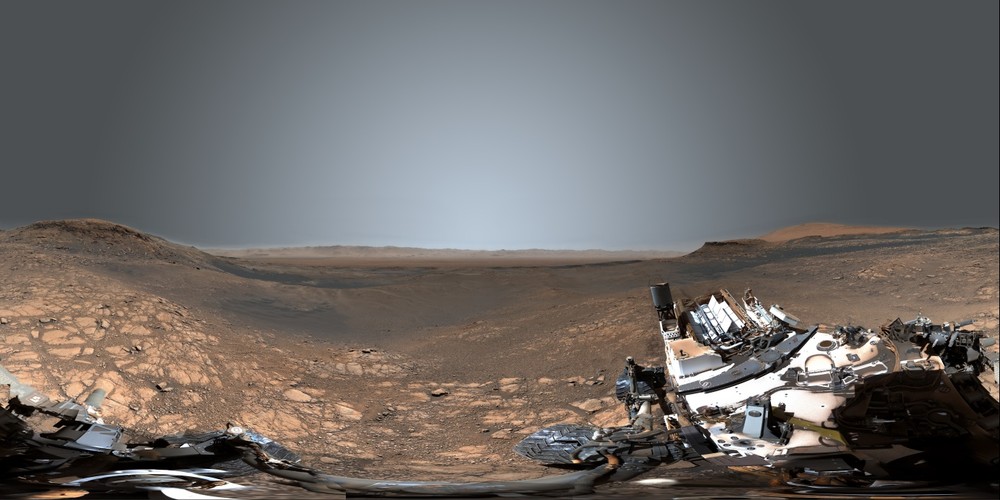
 Mars Curiosity Rover High Resolution Panorama- for VR
4 Gigapixel Panoramic Image from NASAs Curiosity Rover on Mars VR view: https://3d-360.com/gigakrindex.php?width=88768&height=44384&id=219991&fov=360
NASAs Curiosity rover captured its highest-resolution panorama yet of the Martian surface between Nov. 24 and Dec. 1, 2019. A version without the rover contains nearly 1.8 billion pixels; a version with the rover contains nearly 650 million pixels. Both versions are composed of more than 1,000 images that were carefully assembled over the following months.
The rover's Mast Camera, or Mastcam, used its telephoto lens to produce the panorama and relied on its medium-angle lens to produce a lower-resolution panorama that includes the rover's deck and robotic arm.
Malin Space Science Systems in San Diego built and operates Mastcam. A division of Caltech, NASA's Jet Propulsion Laboratory manages the Mars Science Laboratory mission for the agency's Science Mission Directorate in Washington and built the Curiosity rover.
For more information about Curiosity, visit:
https://mars.nasa.gov
https://www.nasa.gov/mission_pages/msl/index.html
Credit
NASA/JPL-Caltech/MSSS
This image is a composite of the two images with an artificial sky added above the horizon to create a full equirectangular spherical panorama. Composite by Jason Buchheim
Best Viewed in Virtual Reality or as a 360 degree panorama here:
https://3d-360.com/gigakrindex.php?width=88768&height=44384&id=219991&fov=360
Uploaded Mar 27, 2020 by Jason Buchheim username:odyssey copyright 2019
88,768px by 44,384px, 3.94 Gigapixels
| Unmounted | Acrylic Museum Mount |
| Purchase Prints | Matte | Glossy | Lustre | Metalic | Deep Glossy | Deep Glossy |
| 12" x 24" | | | | | | |
| 18" x 36" | | | | | | |
| 24" x 48" | | | | | | |
| 30" x 60" | | | | | | |
| 36" x 72" | | | | | | |
VIEW OPTIONS please select the approximate angle of view of the image
Flat 1° 10° 45° 90° 170°
Sphere 45° 90° 180° 270° 360°
Odyssey Expeditions Panoram.io VR billboard style
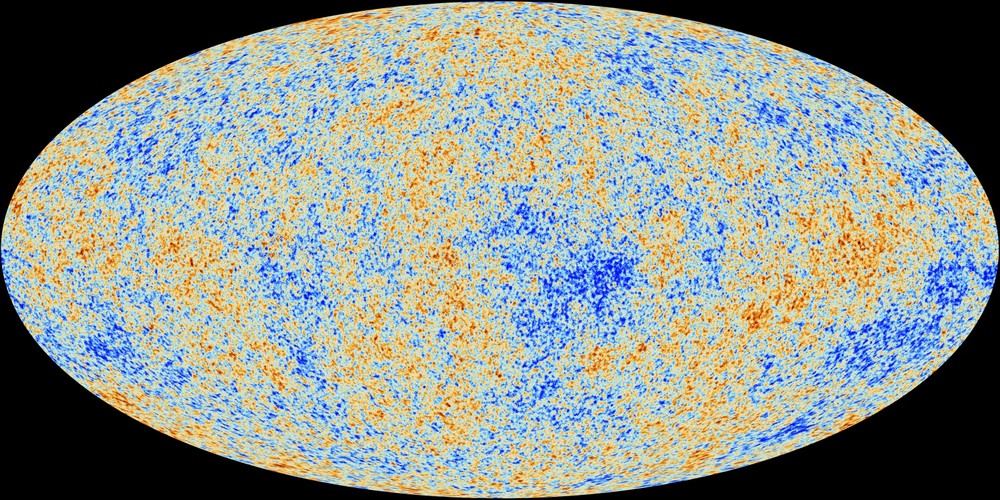 Cosmic Background Radiation
This is the highest resolution image available from the European Space Agency of the Cosmic Background Radiation Map produced by the Planck Sattelite Observatory. Image From the European Space Agency. In Mollweide format.
Uploaded Aug 27, 2013 by Jason Buchheim username:odyssey copyright
12,572px by 6,286px, 0.08 Gigapixels
| Unmounted | Acrylic Museum Mount |
| Purchase Prints | Matte | Glossy | Lustre | Metalic | Deep Glossy | Deep Glossy |
| 12" x 24" | | | | | | |
| 18" x 36" | | | | | | |
VIEW OPTIONS please select the approximate angle of view of the image
Flat 1° 10° 45° 90° 170°
Sphere 45° 90° 180° 270° 360°
Odyssey Expeditions Panoram.io VR billboard style
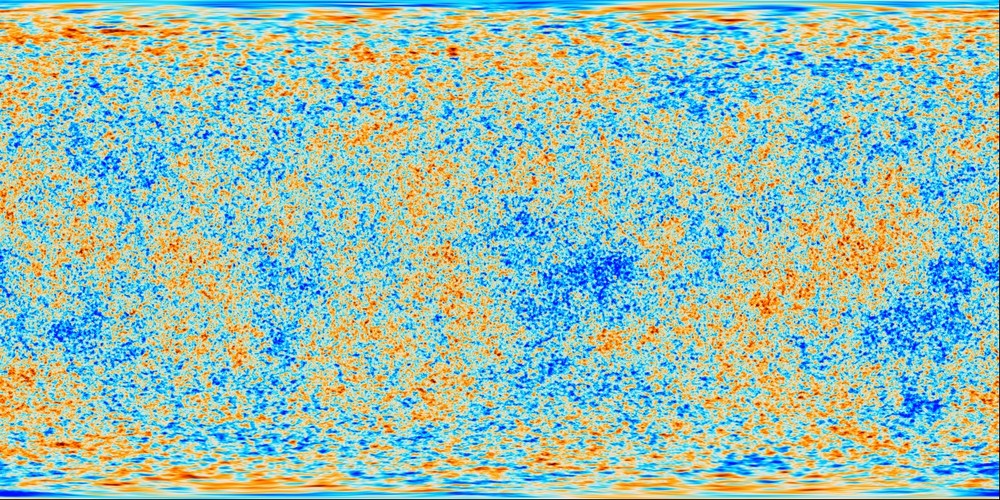 Planck's View of the Cosmic Background Radiation
This image is best viewed in a 360 degree virtual reality viewer at http://www.stereopan.com/138386 .
.
This map shows the oldest light in our universe, as detected with the greatest precision yet by the Planck mission. The ancient light, called the cosmic microwave background, or CMB, was imprinted on the sky when the universe was 370,000 years old. It shows tiny temperature fluctuations that correspond to regions of slightly different densities, representing the seeds of all future structure: the stars and galaxies of today.
.
By analyzing the light patterns in this map, scientists are fine tuning what we know about the universe, including its origins, fate and basic components.
.
This map was constructed from an analysis of observations of the sky at wavelengths of light spanning 850 microns to 1 cm (353 GHz to 30 GHz). Additional observations spanning 350 to 550 microns (857 to 545 GHz) helped characterize foreground dust in the Milky Way, which was removed from the final CMB data shown here.
.
This view of the data is in an equirectangular projection suitable for projection onto a sphere, and is useful for full-dome presentations. The projection is in galactic coordinates with the galactic plane running horizontally along the midpoint of the image. Note that most graphics software will map images to the outside of a sphere; since this is the inside projection looking outwards the image should be flipped horizontally when used with such software.
.
Planck is a European Space Agency mission, with significant participation from NASA. NASA's Planck Project Office is based at NASA's Jet Propulsion Laboratory, Pasadena, Calif. JPL contributed mission-enabling technology for both of Planck's science instruments. European, Canadian and U.S. Planck scientists work together to analyze the Planck data.
On a side note, this was probably amongst the most expensive 'Gigapans' to produce;)
Uploaded Aug 25, 2013 by Jason Buchheim username:odyssey copyright
10,000px by 5,000px, 0.05 Gigapixels
| Unmounted | Acrylic Museum Mount |
| Purchase Prints | Matte | Glossy | Lustre | Metalic | Deep Glossy | Deep Glossy |
| 12" x 24" | | | | | | |
VIEW OPTIONS please select the approximate angle of view of the image
Flat 1° 10° 45° 90° 170°
Sphere 45° 90° 180° 270° 360°
Odyssey Expeditions Panoram.io VR billboard style
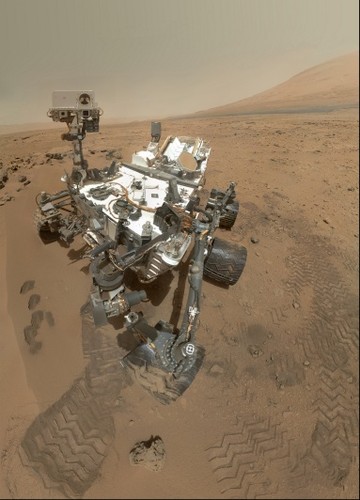 High-Resolution Self-Portrait by Curiosity Rover Arm Camera - PIA16239
On Sol 84 (Oct. 31, 2012), NASA's Curiosity rover used the Mars Hand Lens Imager (MAHLI) to capture this set of 55 high-resolution images, which were stitched together to create this full-color self-portrait.
The mosaic shows the rover at "Rocknest," the spot in Gale Crater where the mission's first scoop sampling took place. Four scoop scars can be seen in the regolith in front of the rover.
The base of Gale Crater's 3-mile-high (5-kilometer) sedimentary mountain, Mount Sharp, rises on the right side of the frame. Mountains in the background to the left are the northern wall of Gale Crater. The Martian landscape appears inverted within the round, reflective ChemCam instrument at the top of the rover's mast.
Self-portraits like this one document the state of the rover and allow mission engineers to track changes over time, such as dust accumulation and wheel wear. Due to its location on the end of the robotic arm, only MAHLI (among the rover's 17 cameras) is able to image some parts of the craft, including the port-side wheels.
This high-resolution mosaic is a more detailed version of the low-resolution version created with thumbnail images, at PIA16238.
JPL manages the Mars Science Laboratory/Curiosity for NASA's Science Mission Directorate in Washington. The rover was designed, developed and assembled at JPL, a division of the California Institute of Technology in Pasadena.
For more about NASA's Curiosity mission, visit: http://www.jpl.nasa.gov/msl, http://www.nasa.gov/mars, and http://mars.jpl.nasa.gov/msl.
Image Credit:
NASA/JPL-Caltech/Malin Space Science Systems
Image Addition Date:
2012-11-01
Uploaded Nov 5, 2012 by Jason Buchheim username:odyssey copyright
6,114px by 8,500px, 0.05 Gigapixels
| Unmounted | Acrylic Museum Mount |
| Purchase Prints | Matte | Glossy | Lustre | Metalic | Deep Glossy | Deep Glossy |
| 12" x 9" | | | | | | |
| 18" x 13" | | | | | | |
| 24" x 17" | | | | | | |
VIEW OPTIONS please select the approximate angle of view of the image
Flat 1° 10° 45° 90° 170°
Sphere 45° 90° 180° 270° 360°
Odyssey Expeditions Panoram.io VR billboard style
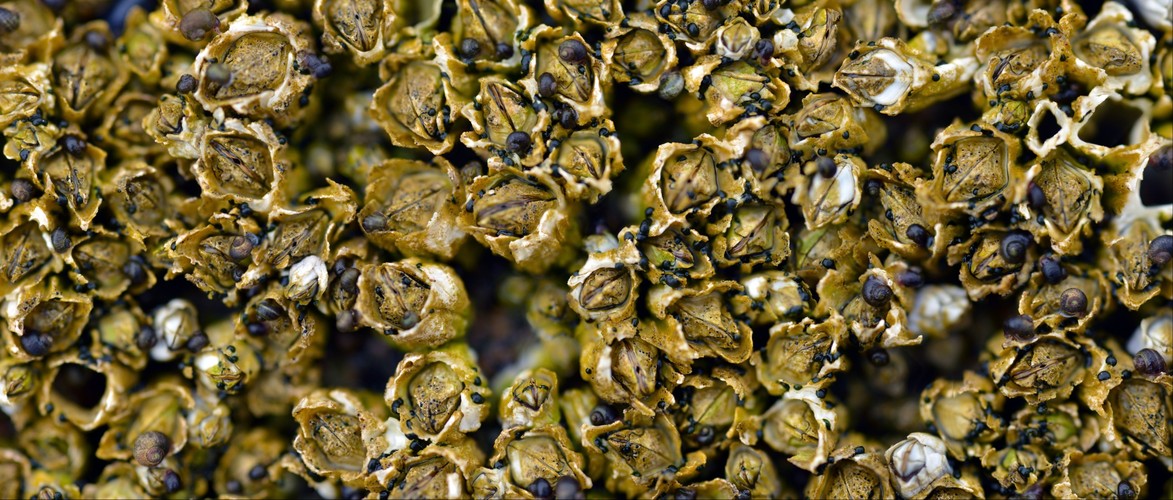 Barnacles, Mussels, Snails - Rocky Intertial Acadia Maine
Barnacles, periwinkles, and blue mussels crowded together on exposed granite — this is the intertidal zone of Acadia National Park, Maine, and few ecological communities on the Atlantic coast are as rugged, competitive, or quietly dramatic as this one.
Acadia's Intertidal
The rocky coastline of Acadia National Park along Mount Desert Island represents some of the most studied and celebrated intertidal habitat in North America. Shaped by some of the most extreme tidal ranges on the U.S. East Coast — regularly swinging six to twelve feet between low and high tide — these rocks are exposed to air, drenched in seawater, baked by summer sun, and locked in winter ice, sometimes within the same day. Life here is organized into distinct horizontal bands, each species staking out the precise elevation it can physiologically tolerate.
The Barnacles
The dominant barnacles in Acadia's intertidal are most likely acorn barnacles — primarily Semibalanus balanoides, the northern rock barnacle, which carpets the mid-to-high intertidal in dense, chalk-white colonies. What appears to be a crusty mineral encrustation is actually a community of animals. Each cone is an individual crustacean — closely related to crabs and shrimp — that has cemented its head permanently to the rock and built a volcano-shaped limestone fortress around itself. When submerged, the plates at the top open and feathery feeding appendages called cirri sweep the water for plankton in rhythmic, raking strokes. When the tide retreats, the plates clamp shut, sealing in moisture and protecting soft tissue from desiccation and predators. A barnacle can survive hours of aerial exposure that would kill most marine invertebrates.
The Periwinkles
The small snails grazing among the barnacles are almost certainly common periwinkles (Littorina littorea), an intertidal species so successful it has become one of the dominant grazers on the entire New England coast. Periwinkles rasp algae and biofilm from rock surfaces using a ribbon of tiny teeth called a radula, and their grazing pressure actually shapes which species of algae and organisms can establish themselves — making them quiet but powerful ecological engineers. They are extraordinarily tolerant of exposure, capable of sealing their shell opening with a tough plate called an operculum and entering a dormant state during low tide. Periwinkles are also, notably, a non-native species introduced from Europe in the 1800s that has thoroughly naturalized into the New England intertidal ecosystem.
The Mussels
The blue mussels (Mytilus edulis) nestled into the barnacle matrix represent the intertidal's master colonizer. Mussels attach to rock and to each other using byssus threads — strong, elastic protein fibers secreted from a gland near the foot — forming dense mats that can eventually outcompete barnacles for space if left unchecked. They are filter feeders, drawing water through their gills and straining out phytoplankton and suspended organic matter with extraordinary efficiency. A single mussel can filter more than a liter of seawater per hour. Their aggregations create habitat for dozens of other small invertebrates — worms, amphipods, small crabs — sheltering within the mussel matrix like a city within a city.
The Competition
What looks like a static rock surface is in ecological terms a slow-motion battlefield. Barnacles, mussels, algae, and periwinkles are in perpetual competition for the most precious intertidal resource — bare rock to settle on. Barnacles colonize open space quickly after disturbance, mussels can overgrow them, sea stars (Asterias forbesi and A. vulgaris) prey heavily on mussels from below at low tide, and winter ice scour periodically resets patches to bare rock and starts the succession over. The ecologist Robert Paine's foundational work on intertidal community structure — including the concept of the keystone species — grew directly out of research conducted in this kind of rocky intertidal habitat.
Seasonality in Maine
In Acadia, the intertidal community shifts with the seasons in ways invisible in warmer climates. Barnacles spawn in late winter and early spring, releasing nauplii larvae into frigid water. By late spring, newly settled barnacle spat — barely visible to the naked eye — dust the rock in a faint haze of white. Summer brings maximum biological activity, predation pressure, and algal growth. Winter strips some of the softer community back and, in hard freeze years, ice rafting physically tears mussel beds and barnacle patches from the rock entirely, creating the disturbance patches that the community then races to recolonize come spring.
Uploaded Oct 10, 2012 by Jason Buchheim username:odyssey copyright
17,708px by 7,547px, 0.13 Gigapixels
| Unmounted | Acrylic Museum Mount |
| Purchase Prints | Matte | Glossy | Lustre | Metalic | Deep Glossy | Deep Glossy |
| 12" x 28" | | | | | | |
| 18" x 42" | | | | | | |
| 24" x 56" | | | | | | |
VIEW OPTIONS please select the approximate angle of view of the image
Flat 1° 10° 45° 90° 170°
Sphere 45° 90° 180° 270° 360°
Odyssey Expeditions Panoram.io VR billboard style
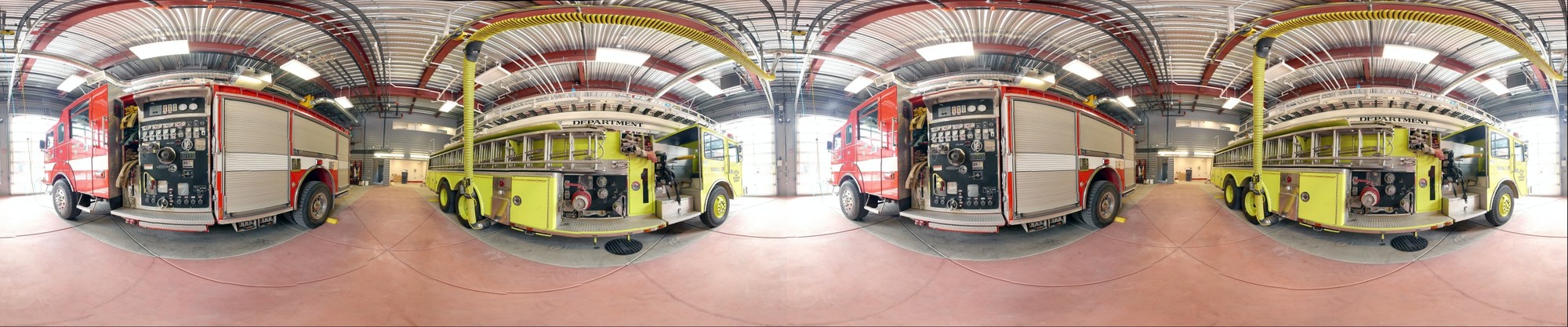 Aspen Fire Department House in Stereo 3D
Full 720 degree stereo 3D view of the new Aspen, Colorado fire department one day before opening.
This is an HDR tonemapped image made from 420 frames and stitched in PtGUI.
Best viewed in 3D Stereo 'Cross-View' Format here: http://www.3dpan.org/3d/48328-48328-360-360 (Pan to the LEFT initially for cross-view, pan to the RIGHT initially for parallel-view, currently if you pan past 360 degrees it will swap cross-parallel views, so if it does not look right, that is what happened, try reloading the page to reset)
The realestate tycoons wanted to convert the old fire department building into a Gucci store, but cooler heads prevaled and they built this beautiful new building instead. Now 1/3 of Aspen's retails space is vacant, sure would have been a shame to have put the fire department building down by the airport.
Uploaded Apr 26, 2010 by Jason Buchheim username:odyssey copyright 2010
47,421px by 9,894px, 0.47 Gigapixels
| Unmounted | Acrylic Museum Mount |
| Purchase Prints | Matte | Glossy | Lustre | Metalic | Deep Glossy | Deep Glossy |
| 12" x 58" | | | | | | |
| 18" x 86" | | | | | | |
| 24" x 115" | | | | | | |
| 30" x 144" | | | | | | |
VIEW OPTIONS please select the approximate angle of view of the image
Flat 1° 10° 45° 90° 170°
Sphere 45° 90° 180° 270° 360°
Odyssey Expeditions Panoram.io VR billboard style
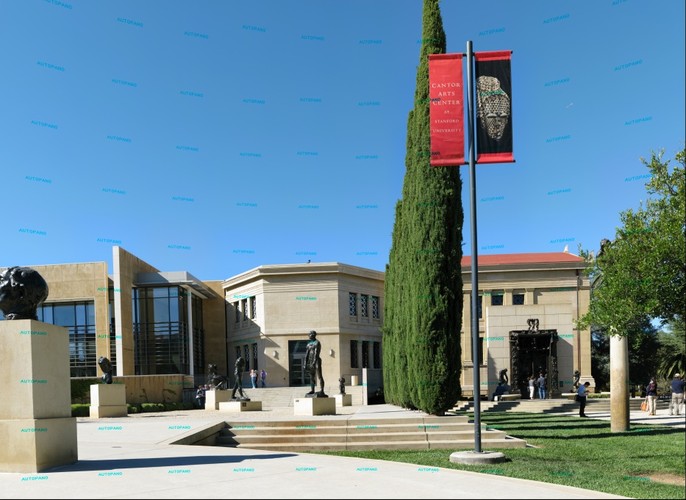 Ronin Test Suite stitched by Autopano Giga Alpha 1.9
This 10x10 Benchmark image suite was stiched by the Alpha 1 release of AutopanoGiga by Autopano.net. I could find no stitchng erros. The watermark is because the program is in 'Trial' mode. And try it I did. Benchmarked 8 different computer configurations and compared them with the Gigapan Stitcher.
Having an older computer system I was having enormous difficulty actually getting through any large stitching projects, so I recently build a new state of the art (for this month) computer system and it is a speed demon compared to my previous hardware. Having seen very significant improvements in my stitching speed, I wanted to know which elements in the new system gives rise to the new stellar performance as I did not know if it is processor, memory, or drive speed related. I know that many of the Gigapan users would like to optimise their computer systems for stitching, so I worked on a thorough study of the variables I could manipulate.
I was particularly interested in the following in relation to total stitching time:
System Memory Size, options tested were 2GB, 4GB, and 8GB
System Memory Speed, in the 4GB configuration, tested between running the two sticks of memory at 800 and 1033 MHz memory clock speeds.
Hard Drive Type, tested between stitching (with source images, destination image, and system cache all on the target drive) between a single 300GB Seagate 7200 RPM SATA drive and a RAID 0 (Stripping) array consisting of four Western Digital Velociraptor 10,000 RPM 150GB drives
Stitching Software, tested Gigapan Stitcher 0.4.3510 and Autopano Giga Alpha Release 1.90
The image set was Randy's Ronin Sculpture set, a 10x10 image array that produces a .5 gigapixel image.
Method:
My base system consists of a Intel Quad Core q9550 running at stock 2.83GHz set into a MSI P45 Platinum motherboard (Intel Chipset) and Geforce 8800 GTS GPU, 850 watt power supply and Corsair PC8500 4x2GB memory with Windows Vista Ultimate as OS.
During all tests I had the Windows Vista Task Manager and Performance Monitor running and displayed.
When testing between the different hard drives, I had the source images and destination image or directory on the same drive and assigned Windows to use that drive for Virtual Memory Swap Space.
As it was a single stick of memory, when running in 2GB the system was not running Dual Channel. When running in 4GB and 8GB the memory was populated for Dual Channel.
Timing of all stitches was done by looking at the file creation and modified time for the created Autopano .PSB images and calculating the difference. For the Gigapan stitches I looked at the 'Additional Info' tab.
Only one sample of each configuration was performed. Minimal other tasks were occurring on the system during the tests.
I pulled out and plugged in memory modules between the sets and rebooted the computer for each change in memory configuration and drive swap space location change.
Here are the results.
Autopano 2Gb memory @ 800 MHz RAID drive: 717 seconds
Autopano 2Gb memory @ 800 MHz SINGLE drive: 1315 seconds
Autopano 4Gb memory @ 800 MHz RAID drive: 707 seconds
Autopano 4Gb memory @ 800 MHz SINGLE drive: 1278 seconds
Autopano 4Gb memory @ 1066 MHz RAID drive: 702 seconds
Autopano 4Gb memory @ 1066 MHz SINGLE drive: 1335 seconds
Autopano 8Gb memory @ 800 MHz RAID drive: 718 seconds
Autopano 8Gb memory @ 800 MHz SINGLE drive: 1225 seconds
Gigapan 2Gb memory @ 800 MHz RAID drive: 2592 seconds
Gigapan 2Gb memory @ 800 MHz SINGLE drive: 2890 seconds
Gigapan 4Gb memory @ 800 MHz RAID drive: 2430 seconds
Gigapan 4Gb memory @ 800 MHz SINGLE drive: 2972 seconds
Gigapan 4Gb memory @ 1066 MHz RAID drive: 2411 seconds
Gigapan 4Gb memory @ 1066 MHz SINGLE drive: 3025 seconds
Gigapan 8Gb memory @ 800 MHz RAID drive: 2406 seconds
Gigapan 8Gb memory @ 800 MHz SINGLE drive: 2644 seconds
Autopano set to use just one core, 8Gb memory @ 800 MHz RAID drive: 2480 seconds (statistically the same as the Gigapan Stitcher at same machine specs and just a little less than four times longer then when run with four cores)
My old system with 1 CPU AMD 3200+ 64 Bit Windows Ultimate and 500Gb 7200 RPM Western Digital Drive, 2GB DDR2 200 memory using the Gigapan stitcher: 7400 seconds
With the results statistically analyzed with JMP software: click this link to view full image http://farm4.static.flickr.com/3053/2931692487_43ed0831c2_o.jpg
Discussion:
Most important factor of all was the number of cores running (and Autopano is the only multicore enabled mosaic stitcher at the present time). The Autopano maxes out all of the CPU's cores, the Gigapan only uses one.
The RAID drive also has a very significant effect, especially with the Autopano software (which, using multiple cores gets limited more by the disk subsystem than the processor). It does not provide as grand of improvements with the Gigapan stitcher probably because the system when running Gigapan Stitcher is being limited more by the processor rather than the disk subsystem. For Autopano the RAID array provided a 80-100% boost in speed but the Gigapan stitcher only gets about a 25% boost. I have not tried the Autopano stitcher with the single core option and the single drive but imagine it would have the same performance as the Gigapan Stitcher with the same setup.
The two programs seem to produce the same result. I did not ever find any glaring errors in the stitched output.
There does not seem to be any big differences in efficiency between the two program as per stitching. Of course the Gigapan stitcher lets you upload right from the stitcher. The Autopano would require you to fire up the Gigapan uploader. But on the bright side, you don't have to take the time to export your panoramas (which I always do) as they are already saved as .PSD or .PSB files. I am a big fan of the .PSB format, and Autopano can include the projected images as separate placed layers too, best for getting rid of those ghosts (although PTGui does a better job with providing editable masking in its .PSB exports). With the Autopano stitcher you can crop and change projection, etc. before rendering, so you can avoid a time consuming task of loading up the image in Photoshop to do so post rendering.
The amount of memory was not a significant player between any of the tests, I guess with a 100 image stitch, 2Gb memory is enough (I did not try 1Gb and did not have 16Gb to try with, maybe if it could keep the whole process and images in memory it could fit in 16Gb, but I bet that a large 1000 image pano would overwhelm even that amount of memory pretty fast.)
The memory speed had no effect when running at 4Gb memory. No significant improvement was found between any of the tests when running at a memory clock of 800 and 1066 (so what is the point of the faster memory I wonder?)
I find it curious how incredibly much slower my 'old' system was, as even though it was a single core AMD, it was running a higher clock frequency than my new multicore processor, so when using a single core program and the same disk system, I would have though they would have been more comparable. Its probably to do with the size of the onchip cache between the 5 year old and the new processor. I should try sticking the old 200 speed memory in and see what stitching time it has.
Conclusion:
Get the fastest processor you can get and pair it up with a RAID array. Use multicore stitching when and if you can (the Autopano Giga is still in Alpha testing stage and has significant bugs, none of which did I encounter, but their forum is full of them) Hopefully the Gigapan stitcher will soon be multicore ready????!!!!
I hope this helps you! I dont ever want to stitch the same image set 18 times again;)
Uploaded Oct 11, 2008 by Jason Buchheim username:odyssey copyright 2008
29,835px by 21,757px, 0.65 Gigapixels
| Unmounted | Acrylic Museum Mount |
| Purchase Prints | Matte | Glossy | Lustre | Metalic | Deep Glossy | Deep Glossy |
| 12" x 16" | | | | | | |
| 18" x 25" | | | | | | |
| 24" x 33" | | | | | | |
| 30" x 41" | | | | | | |
| 36" x 49" | | | | | | |
VIEW OPTIONS please select the approximate angle of view of the image
Flat 1° 10° 45° 90° 170°
Sphere 45° 90° 180° 270° 360°
Odyssey Expeditions Panoram.io VR billboard style
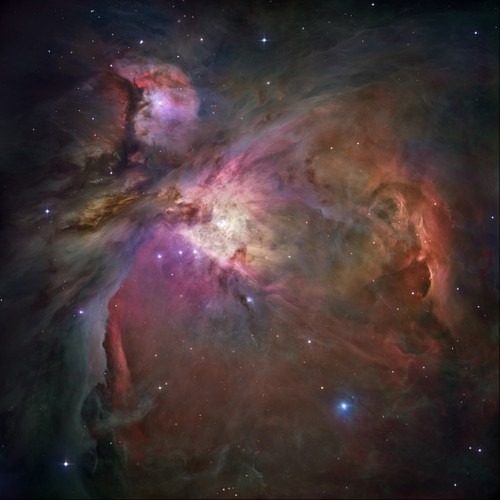 Hubble Panoramic View of Orion
n one of the most detailed astronomical images ever produced, NASA's Hubble Space Telescope captured an unprecedented look at the Orion Nebula. This turbulent star formation region is one of astronomy's most dramatic and photogenic celestial objects. More than 3,000 stars of various sizes appear in this image. Some of them have never been seen in visible light. These stars reside in a dramatic dust-and-gas landscape of plateaus, mountains, and valleys that are reminiscent of the Grand Canyon. The Orion Nebula is a picture book of star formation, from the massive, young stars that are shaping the nebula to the pillars of dense gas that may be the homes of budding stars.
Uploaded Oct 10, 2008 by Jason Buchheim username:odyssey copyright 2008
18,000px by 18,000px, 0.32 Gigapixels
| Unmounted | Acrylic Museum Mount |
| Purchase Prints | Matte | Glossy | Lustre | Metalic | Deep Glossy | Deep Glossy |
| 12" x 12" | | | | | | |
| 18" x 18" | | | | | | |
| 24" x 24" | | | | | | |
| 30" x 30" | | | | | | |
| 36" x 36" | | | | | | |
VIEW OPTIONS please select the approximate angle of view of the image
Flat 1° 10° 45° 90° 170°
Sphere 45° 90° 180° 270° 360°
Odyssey Expeditions Panoram.io VR billboard style
 Space Shuttle Discovery Launch, Florida
Space Shuttle Discovery launches from Cape Canaveral, about 200 miles away from the Howard Park beach on Florida's west cost.
Uploaded Jun 7, 2008 by Jason Buchheim username:odyssey copyright 2008
126,828px by 14,886px, 1.89 Gigapixels
| Unmounted | Acrylic Museum Mount |
| Purchase Prints | Matte | Glossy | Lustre | Metalic | Deep Glossy | Deep Glossy |
| 12" x 102" | | | | | | |
| 18" x 153" | | | | | | |
| 24" x 204" | | | | | | |
| 30" x 256" | | | | | | |
| 36" x 307" | | | | | | |
VIEW OPTIONS please select the approximate angle of view of the image
Flat 1° 10° 45° 90° 170°
Sphere 45° 90° 180° 270° 360°
Odyssey Expeditions Panoram.io VR billboard style
All images uploaded to and reside only at Gigapan®.com. Image copyrights by respective photographers.
This site does not copy or store any images and only provides the viewer KRPANO panorama viewing software, necessary configuration XML and proxy using the public Gigapan® API.