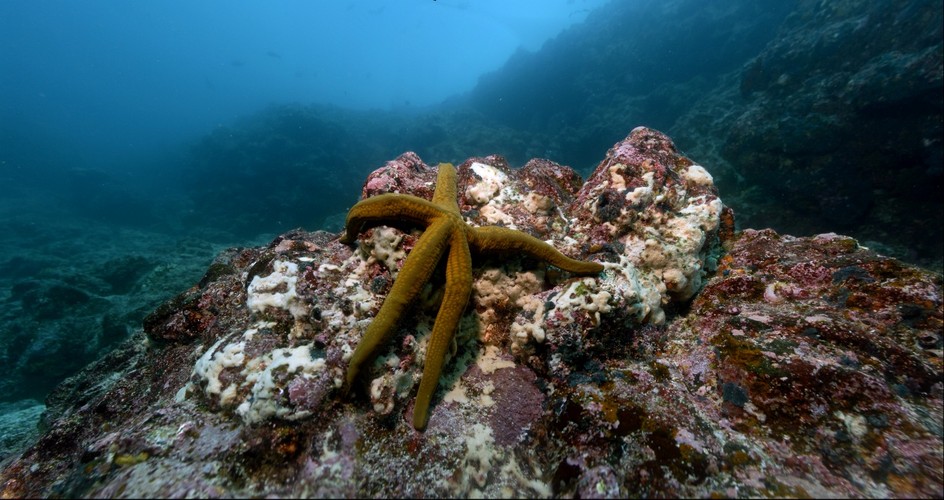
 Galapagos Starfish
A starfish travels across a rock in search of prey
Uploaded Sep 10, 2013 by Jason Buchheim username:odyssey copyright
10,058px by 5,325px, 0.05 Gigapixels
| Unmounted | Acrylic Museum Mount |
| Purchase Prints | Matte | Glossy | Lustre | Metalic | Deep Glossy | Deep Glossy |
| 12" x 23" | | | | | | |
VIEW OPTIONS please select the approximate angle of view of the image
Flat 1° 10° 45° 90° 170°
Sphere 45° 90° 180° 270° 360°
Odyssey Expeditions Panoram.io VR billboard style
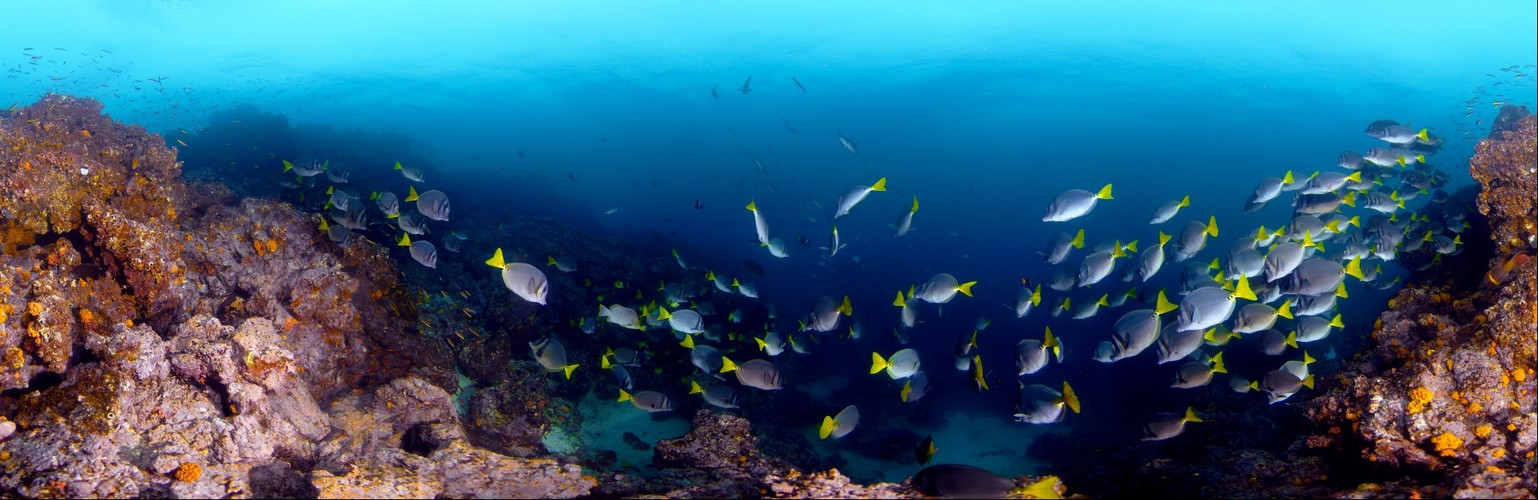
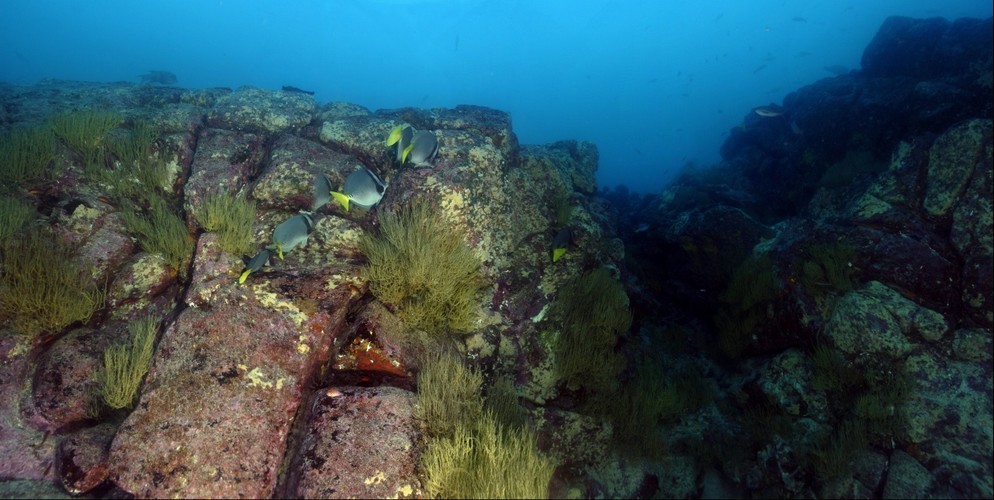 Galapagos Fishes on Wall
Clear water, beautiful, diverse fishes of the Galapagos
Uploaded Sep 10, 2013 by Jason Buchheim username:odyssey copyright
10,783px by 5,425px, 0.06 Gigapixels
| Unmounted | Acrylic Museum Mount |
| Purchase Prints | Matte | Glossy | Lustre | Metalic | Deep Glossy | Deep Glossy |
| 12" x 24" | | | | | | |
| 18" x 36" | | | | | | |
VIEW OPTIONS please select the approximate angle of view of the image
Flat 1° 10° 45° 90° 170°
Sphere 45° 90° 180° 270° 360°
Odyssey Expeditions Panoram.io VR billboard style
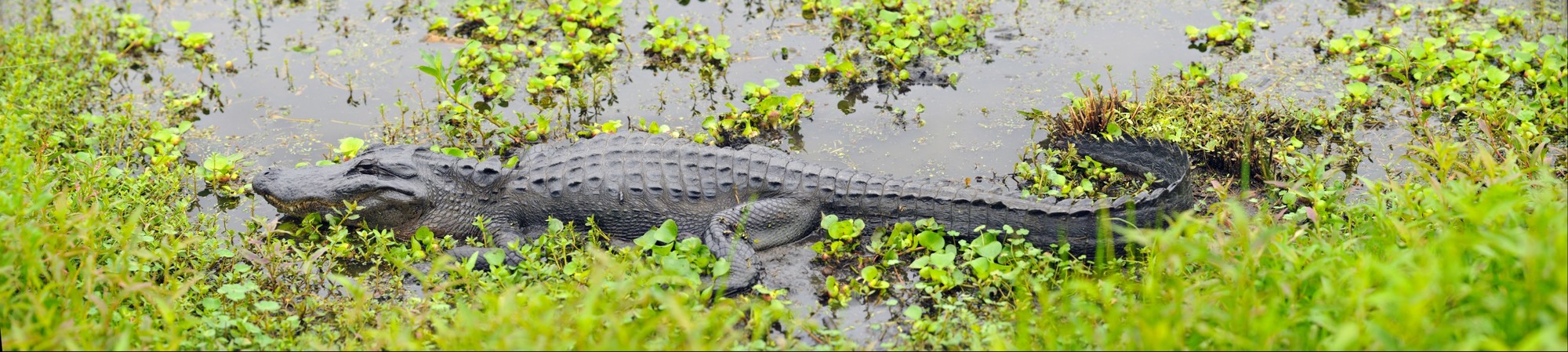 American Alligator in Paynes Prarie, Florida
The American alligator (Alligator mississippiensis) is one of North America's most ancient and successful predators — and Paynes Prairie Preserve State Park, just south of Gainesville, Florida, is one of the finest places on the continent to encounter one in the wild.
.
.
Paynes Prairie
This 21,000-acre basin prairie is a designated National Natural Landmark and one of Florida's most ecologically significant wild places. A shallow, sprawling wetland mosaic of wet prairie, marsh, hammock, and open water, it sits in a natural sinkhole basin whose water levels have risen and fallen dramatically over centuries. It supports an exceptional diversity of wildlife — bison, wild horses, sandhill cranes, and hundreds of bird species — but the alligator reigns here as the apex predator.
.
.
Ancient Lineage
American alligators are living relics of the Mesozoic, with a lineage stretching back more than 37 million years in essentially their current form. They survived whatever ended the dinosaurs and have changed remarkably little since. Encountering one on the boardwalks or trail edges of Paynes Prairie offers a genuine brush with deep evolutionary time.
The Animal Itself
Adult males at Paynes Prairie regularly exceed 10 feet and can approach 13 feet in length, weighing upwards of 500 pounds. Females are considerably smaller, typically reaching 8 to 9 feet. Their armor-like skin, called osteoderms, contains small bony plates beneath the scales that act as a kind of solar panel, absorbing heat directly into the bloodstream — an elegant solution for an ectotherm managing Florida's variable temperatures.
.
.
Behavior and Hunting
Alligators are ambush predators of remarkable patience, capable of remaining motionless for hours at the water's edge. They are opportunistic and will take fish, turtles, wading birds, snakes, and mammals. At Paynes Prairie, they are frequently observed along the La Chua Trail corridor, basking on the levee banks or gliding silently through the shallow marsh. Their bite force is among the strongest of any living animal — measured at over 2,900 pounds per square inch — but their mouths open with surprisingly little force, which is why hatchlings can be held shut with a single hand.
.
.
Bellowing and Breeding
Spring at Paynes Prairie brings one of nature's more primal spectacles. Males bellow deeply — a resonant, infrasonic rumble that vibrates the water surface into a dancing mist called the "water dance" — to establish territory and attract females. Females build large mound nests of vegetation, and the heat of decomposition incubates the eggs. Nest temperature during a critical period actually determines the sex of the hatchlings — a phenomenon called temperature-dependent sex determination.
.
.
Conservation Comeback
Once hunted nearly to extinction for their hides and listed as endangered in 1967, American alligators rebounded so successfully under federal protection that they were removed from the endangered list by 1987 — one of the Endangered Species Act's earliest and most celebrated conservation successes. Florida today is home to an estimated 1.3 million alligators. Paynes Prairie's healthy, visible population is a direct testament to what protected habitat and legal safeguards can accomplish.
Uploaded Apr 25, 2013 by Jason Buchheim username:odyssey copyright 2013
20,564px by 4,615px, 0.09 Gigapixels
| Unmounted | Acrylic Museum Mount |
| Purchase Prints | Matte | Glossy | Lustre | Metalic | Deep Glossy | Deep Glossy |
| 12" x 53" | | | | | | |
VIEW OPTIONS please select the approximate angle of view of the image
Flat 1° 10° 45° 90° 170°
Sphere 45° 90° 180° 270° 360°
Odyssey Expeditions Panoram.io VR billboard style
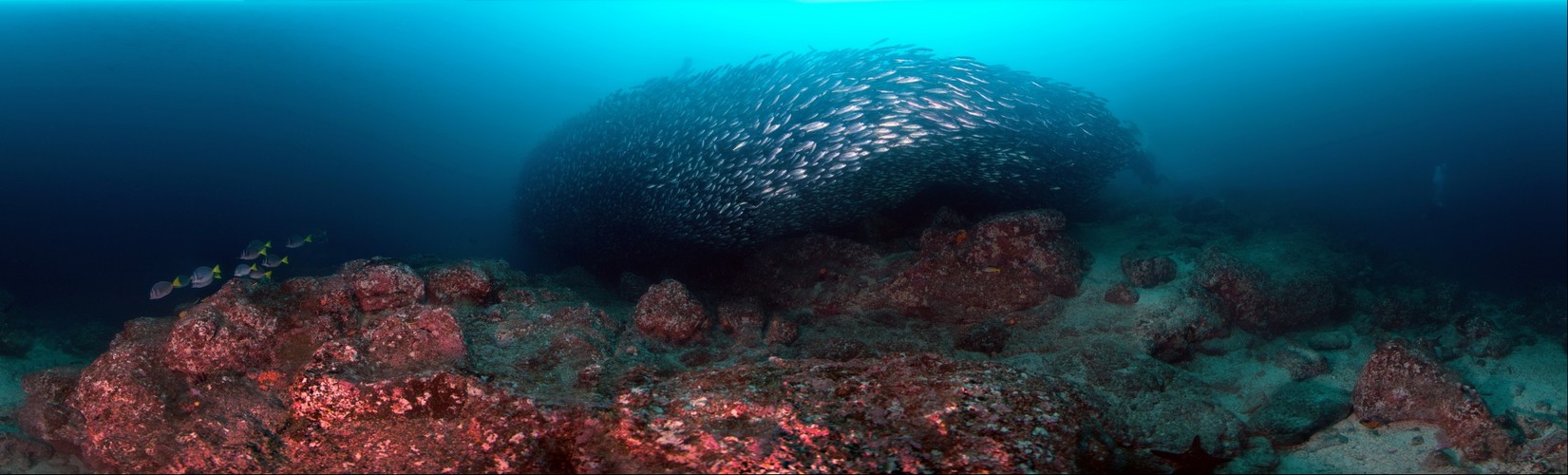 Bait Ball of Salema Fish
Bait Ball of Salema Fish
Uploaded Jan 4, 2013 by Jason Buchheim username:odyssey copyright
16,514px by 5,000px, 0.08 Gigapixels
| Unmounted | Acrylic Museum Mount |
| Purchase Prints | Matte | Glossy | Lustre | Metalic | Deep Glossy | Deep Glossy |
| 12" x 40" | | | | | | |
VIEW OPTIONS please select the approximate angle of view of the image
Flat 1° 10° 45° 90° 170°
Sphere 45° 90° 180° 270° 360°
Odyssey Expeditions Panoram.io VR billboard style
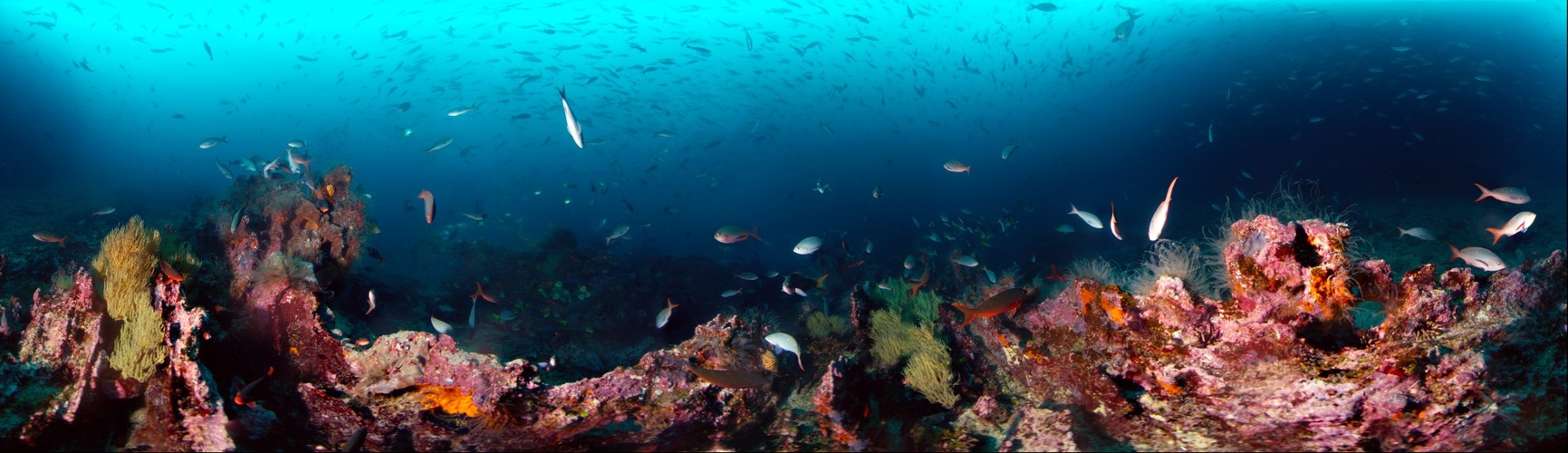 Fishes on the Reef
Fishes on the Galapagos Reef- looks best in 360 degree viewer here: http://www.3d-360.com/121047
Uploaded Jan 4, 2013 by Jason Buchheim username:odyssey copyright
17,309px by 5,000px, 0.09 Gigapixels
| Unmounted | Acrylic Museum Mount |
| Purchase Prints | Matte | Glossy | Lustre | Metalic | Deep Glossy | Deep Glossy |
| 12" x 42" | | | | | | |
VIEW OPTIONS please select the approximate angle of view of the image
Flat 1° 10° 45° 90° 170°
Sphere 45° 90° 180° 270° 360°
Odyssey Expeditions Panoram.io VR billboard style
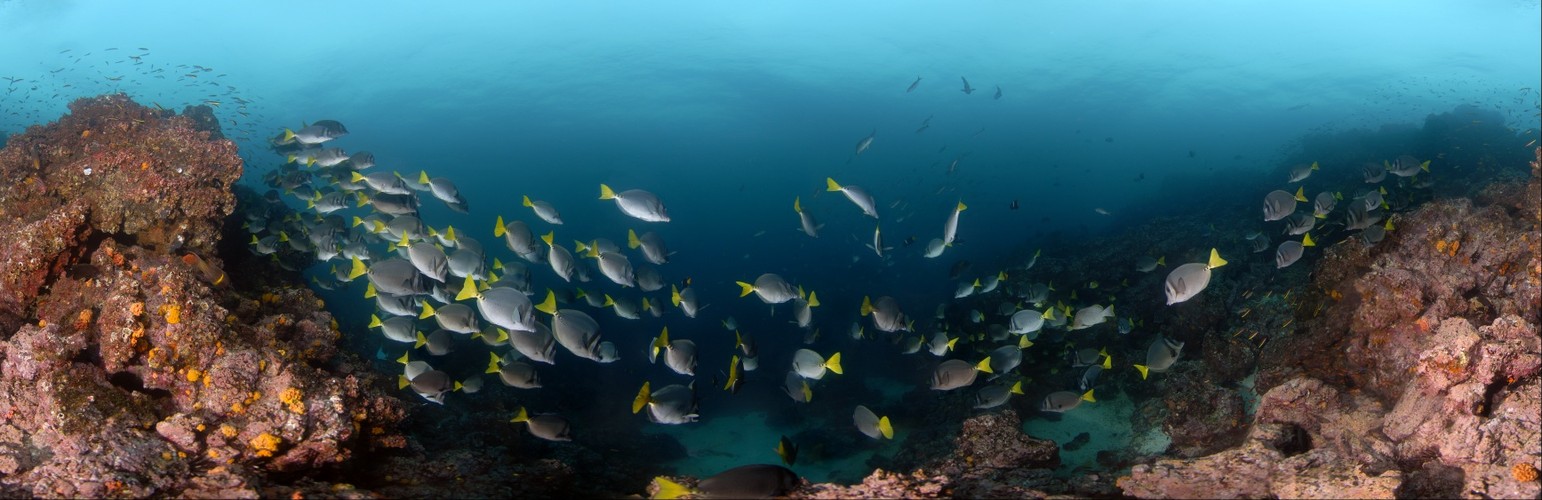 Surgeon Fish - Galapagos
Surgeon Fish in the Galapagos, full 360 panorama. Best viewed in virtual reality viewer at http://www.3dpan.org/65153 or in Google Earth.
Uploaded Nov 18, 2010 by Jason Buchheim username:odyssey copyright 2010
13,875px by 4,500px, 0.06 Gigapixels
| Unmounted | Acrylic Museum Mount |
| Purchase Prints | Matte | Glossy | Lustre | Metalic | Deep Glossy | Deep Glossy |
| 12" x 37" | | | | | | |
VIEW OPTIONS please select the approximate angle of view of the image
Flat 1° 10° 45° 90° 170°
Sphere 45° 90° 180° 270° 360°
Odyssey Expeditions Panoram.io VR billboard style
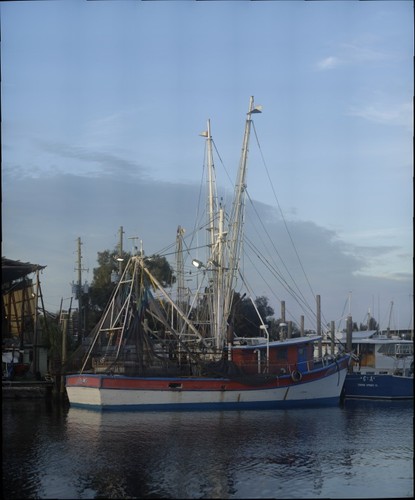 Tarpon Springs Shrimp Boat
Tarpon Springs is home to shrimp boats and sponge divers. The crew of this boat were preparing for a night of fishing.
This is protorapghed with the aid of the Gigapan Epic Pro robotic panoramic mount. Taken on my first day of beta testing this unit.
I used a 50-500mm Sigma lens on a Nikon D200. The lens was set at 300mm. The Gigapan unit was set to digitally fire the shutter (twice per frame, one for mirror lock up so that I could reduce movement, and one for taking the photo).
I am suprised to see the vingetting, I should try and correct that before sending the images to the stitcher.
The light was failing, so I opend up the lens as wide as it would go (f 6) and left the camera on manual focus and manual exposure. The depth of field is not large on a 300mm lens at f6.
I thought I had the rails on the unit level, but there is still some sawtooth on the edges so I really need to check that out better.
Uploaded Oct 28, 2009 by Jason Buchheim username:odyssey copyright 2009
18,882px by 22,757px, 0.43 Gigapixels
| Unmounted | Acrylic Museum Mount |
| Purchase Prints | Matte | Glossy | Lustre | Metalic | Deep Glossy | Deep Glossy |
| 12" x 10" | | | | | | |
| 18" x 15" | | | | | | |
| 24" x 20" | | | | | | |
| 30" x 25" | | | | | | |
| 36" x 30" | | | | | | |
VIEW OPTIONS please select the approximate angle of view of the image
Flat 1° 10° 45° 90° 170°
Sphere 45° 90° 180° 270° 360°
Odyssey Expeditions Panoram.io VR billboard style
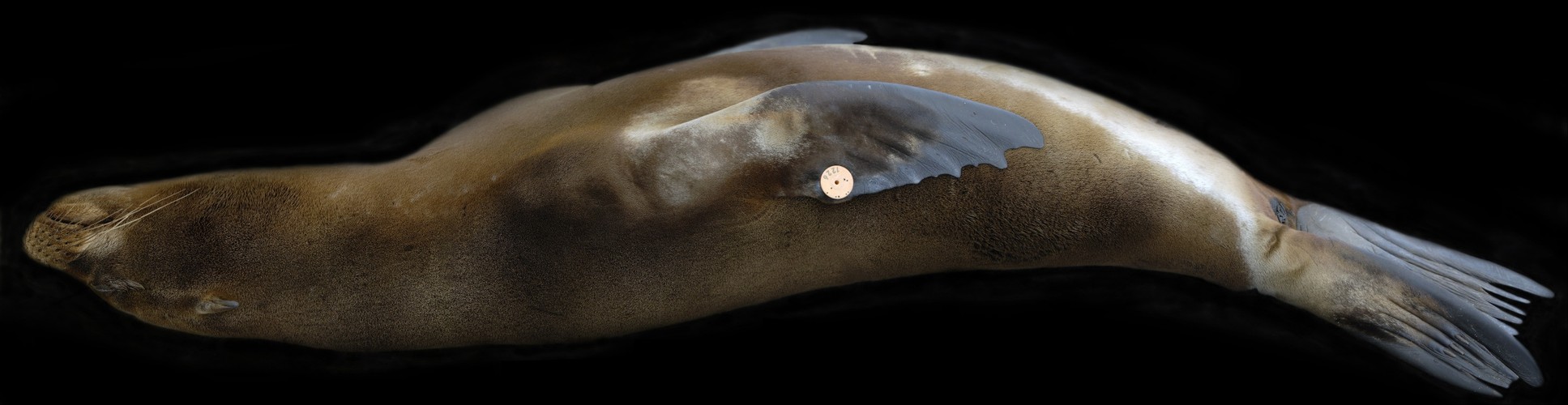 Galapagos Sea Lion Sleeping
Latin Name Zalophus wollebaeki
Conservation Status Vulnerable
Location Galapagos Islands
Colour Brown
Length 150 - 250 cms (59 - 98 inches)
Weight 50 - 400 Kgs (110 - 880 lbs)
Main Characteristics
Galapagos Sea Lions are one of the most conspicuous and numerous marine mammals on the Galapagos Islands. They have a body length between 150 and 250 cms (59 - 98 inches) and they weigh between 50 and 400 Kgs (110 - 880 lbs), males being much larger than females.
Males are coloured brown, females tend to be a lighter tan and juveniles are coloured chestnut brown. Their bodies are streamline and they have well developed fore flippers which they use to propel themselves through the water. They can control their hind flippers independently which enables them to move around more effectively on land.
When males reach puberty they begin to develop a raised forehead and sometimes their hair is lighter coloured on their crest.
Habitat
Galapagos Sea Lions are found on the islands of the Galapagos Archipelago. They spend a lot of their time swimming in the ocean but while on land they prefer sandy beaches and flat rocky areas that have plenty of shade and tidal pools. While at sea they will rarely venture further than 16 Kms (10 miles) from the coast.
Females gather in colonies of approximately 30 individuals and each colony is dominated by one bull. He will hold his territory for a short time before he is displaced by another bull. Bulls that are not dominating a colony will gather together in a bachelor group.
Diet
Galapagos Sea Lions mainly feed upon fish, squid, octopus and crustaceans.
Breeding
Galapagos Sea Lions breed between May and January and mating usually occurs in the water. Males hold their territories for 10 days - 3 months and during this time they aggressively defend it.
After a gestation period of approximately 11 months, females give birth to 1 pup. When the pups are born they weigh approximately 6 Kgs (13.2 lbs) and they are approximately 75 cms (29.5 inches) long. The pups are attended continuously by their mothers for 6 - 7 days after they are born, then the females have to go to sea to feed themselves, returning to their pups at night.
When the pups reach 1 - 2 weeks old they will venture into the water and start to learn how to swim. They are weaned when they reach 11 - 12 months old but because of the long breeding season and the length of time pups are cared for by their mothers, there are dependent pups on the rookeries all year round.
Predators
The main predators of Galapagos Sea Lions are sharks and killer whales. Dogs are also known to prey upon pups.
Interesting Facts
Galapagos Sea Lions are also known as:Pagos Sea Lion
Nikon D200 handheld 9 shots, stitched with PtGui. Brick floor carefully removed in Photoshop leaving a black background.
Uploaded Oct 15, 2009 by Jason Buchheim username:odyssey copyright 2009
18,459px by 4,771px, 0.09 Gigapixels
| Unmounted | Acrylic Museum Mount |
| Purchase Prints | Matte | Glossy | Lustre | Metalic | Deep Glossy | Deep Glossy |
| 12" x 46" | | | | | | |
VIEW OPTIONS please select the approximate angle of view of the image
Flat 1° 10° 45° 90° 170°
Sphere 45° 90° 180° 270° 360°
Odyssey Expeditions Panoram.io VR billboard style
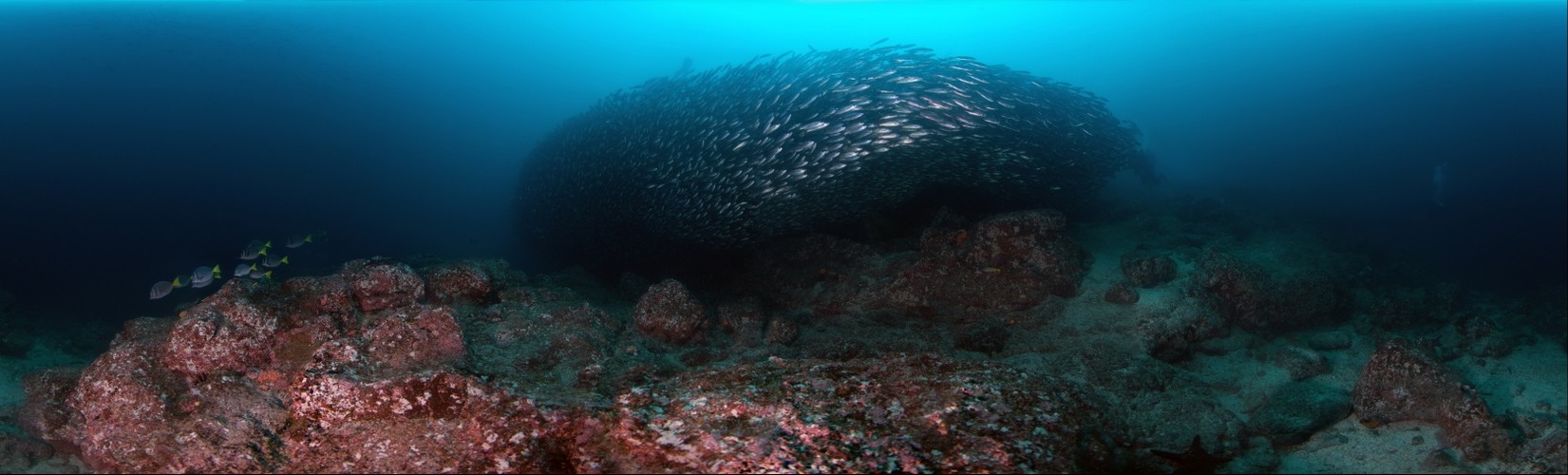 Galapagos Bait Ball of Salema Fish
A huge school of Salema fish avoid predation by aggregating into a ball.
By Odyssey Expeditions Tropical Marine Biology Voyages program director Jason Buchheim. Please visit http://www.odysseyexpeditions.com for more information on our unique educational adventure voyages for teenagers and college students.
D200, 10 photos with 15mm lens for full 360.
This is best viewed in a Virtual Reality 360 degree viewer here: http://www.3dpan.org/34815
A view from INSIDE the bait ball can be found here: http://gigapan.org/gigapans/34662/ or in Virtual Reality viewer here http://www.3dpan.org/34662
Salema fish can actually be hallucinogenic to eat! Known as 'dream fish', the herbivorous fish have toxins in their flesh from the algae that they eat that when ingested by humans produce severe auditory and visual hallucinations. No, I did not try it. It was spooky enough inside the baitball.
Definition of 'Bait Ball': Schools of small fish cruise near the ocean's surface, feeding on plankton and other organic foodstuff. This schooling behavior evolved as a means of protection. If a shark or other predator approaches, the group parts in unison - making it difficult for the invader to target any individual. As a result, this type of attack often fails. Group hunting changes the odds. In a baitball feeding frenzy, a hunting party may consist of bottlenose dolphins, silky sharks, yellowfin tuna, rainbow runners, wahoo, marlin, jacks and even booby birds. They work in a cooperative effort to ensure a feast for all. A typical main course features teeming schools of juvenile jacks and chubs. When a lone predator, usually a shark or dolphin, discovers one of these floating smorgasbords and attacks, a number of events are set into action. Frightened fish elicit a unique odor and other sharks in the area rush to the scene. The fleeing fish then intensify their frantic swimming patterns, alerting even more nearby predators. Now, each member of the murderous team begins to execute its role. The silky sharks and bottlenose dolphins, which are usually mortal enemies, start to surround the school. Gradually, they increase speed and narrow their path, trapping the fish in a tight ball against the surface. Next tuna and marlin rip through the center of the ball, further disorientating the confused prey. Many of the injured bait fish quickly tire and are easily eaten. A full-blown baitball feeding frenzy leaves few survivors. As predators become satiated, new enlistees arrive to continue the slaughter. Against the odds, small groups of baitfish may escape. They will continue to cruise pelagic waters, eating as much as they can as quickly as they can. Once again, the rule of the ocean is clear and simple: get as big as you can before you get eaten.
Please visit http://www.3dpan.org to explore Three Dimensional Stereo panoramas!
Uploaded Oct 15, 2009 by Jason Buchheim username:odyssey copyright 2009
13,396px by 4,056px, 0.05 Gigapixels
| Unmounted | Acrylic Museum Mount |
| Purchase Prints | Matte | Glossy | Lustre | Metalic | Deep Glossy | Deep Glossy |
| 12" x 40" | | | | | | |
VIEW OPTIONS please select the approximate angle of view of the image
Flat 1° 10° 45° 90° 170°
Sphere 45° 90° 180° 270° 360°
Odyssey Expeditions Panoram.io VR billboard style
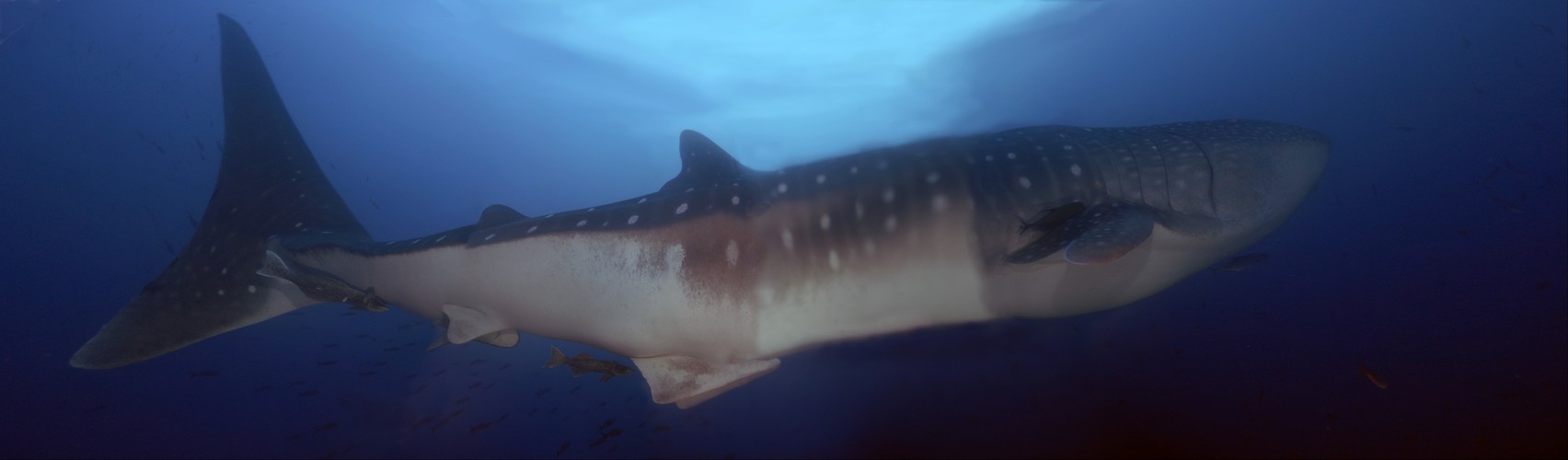 Gigashark Whale Shark Galapagos
So I decided to take a panoramic shot of the worlds largest fish as we swam together at two knots up current in 100 feet of water. Somehow, while holding a large dual flash camera and kicking, kicking, kicking to keep up, I was able to grab 7 frames of this 'Gigashark' as we swam away from the 'Theater' at Darwin's Arch. Darwin Island, Galapagos. Unfortunately, two of the seven frames did not focus... And you don't get any re-try's of this, so I publish it anyways. I really wish my autofocus had been turned off, it just could not find enough contrast on the whale shark midsection's white underside.
I will have to go back and try again someday. It was a thrill and more trying. You literally have to strap yourself to the rocks to stay put in the high currents and wait for these amazing creatures to come out of the blue. Then you release your reef hook and swim out into the blue to meet your new friend.
Whale sharks are baleen feeders, they eat plankton, filtering it out of the water column. They are the largest of all fishes, up to 50 feet long. I believe this one was surely more than 35 feet. Notice the size of the Galapagos shark by its ventral fins.
Uploaded Oct 14, 2009 by Jason Buchheim username:odyssey copyright 2009
13,630px by 4,000px, 0.05 Gigapixels
| Unmounted | Acrylic Museum Mount |
| Purchase Prints | Matte | Glossy | Lustre | Metalic | Deep Glossy | Deep Glossy |
| 12" x 41" | | | | | | |
VIEW OPTIONS please select the approximate angle of view of the image
Flat 1° 10° 45° 90° 170°
Sphere 45° 90° 180° 270° 360°
Odyssey Expeditions Panoram.io VR billboard style
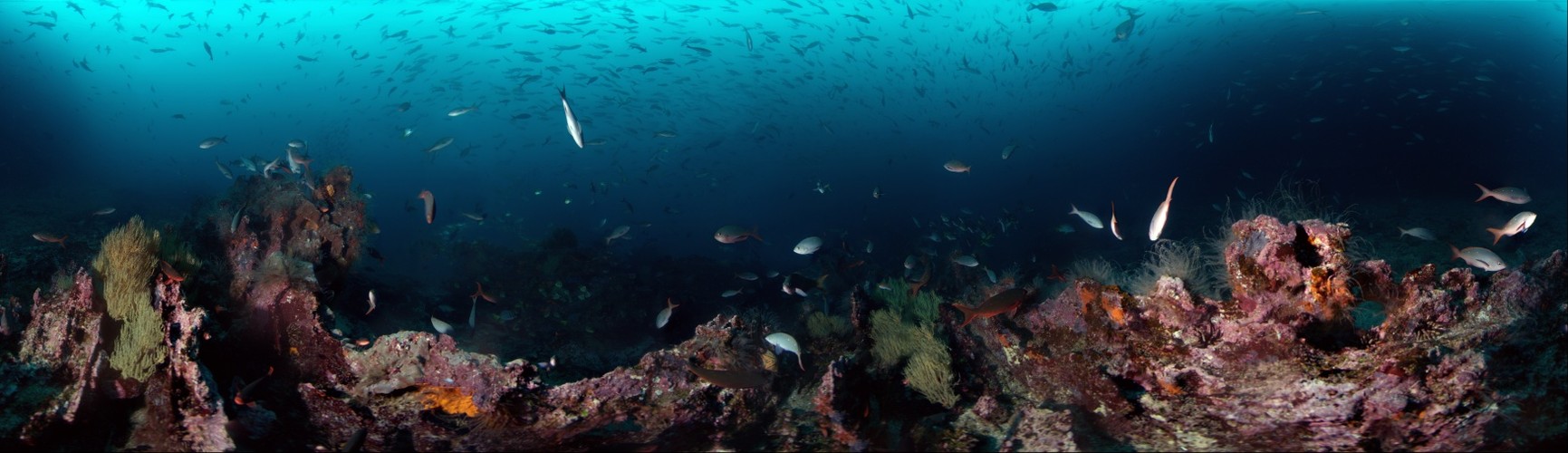 Galapagos Coral Reef and Fishes - 360 degree underwater panorama
The many fishes of the Galapagos Island swim the cool temperate equatorial waters near Bartoleme Island. (9 images stiched with PtGUi with hand layer blending in Photoshop). 15mm lens, Nikon D200 in Ikelite housing and handmade underwater panorama bracket.
Best viewed in 3D Virtual Reality Viewer Here - http://www.3d-360.com/34725
Uploaded Oct 14, 2009 by Jason Buchheim username:odyssey copyright 2009
14,020px by 4,050px, 0.06 Gigapixels
| Unmounted | Acrylic Museum Mount |
| Purchase Prints | Matte | Glossy | Lustre | Metalic | Deep Glossy | Deep Glossy |
| 12" x 42" | | | | | | |
VIEW OPTIONS please select the approximate angle of view of the image
Flat 1° 10° 45° 90° 170°
Sphere 45° 90° 180° 270° 360°
Odyssey Expeditions Panoram.io VR billboard style
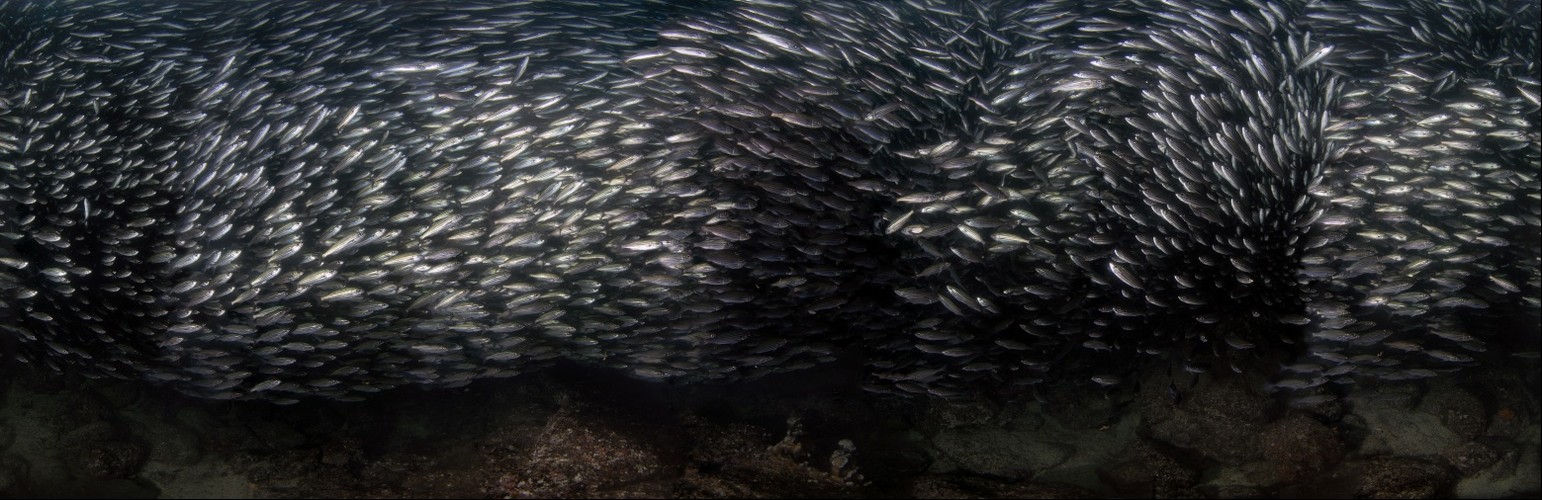 Inside a Galapagos Bait Ball of Black Stripped Salema Fish - 360 degree underwater panorama
On the inside of a 'bait ball' of salema fish off Isabella Island, Galapagos. This is 9 photos taken with a 15mm lens, stiched with PtGui and a lot of photoshop work post processing to try to have each fish complete. This experience is being completely engulfed and surrounded on all sides and above by millions of fish. It darkens the sky! Looks pretty cool in Googleearth. Taken with a housed Nikon D200 with the new Underwater Gigapan Mount (not)! Actually taken with a monopod underwater, rotating the camera lens through its nodal point underwater is challenging and fun. Salema fish can actually be hallucinogenic to eat! Known as 'dream fish', the herbivorous fish have toxins in their flesh from the algae that they eat that when ingested by humans produce severe auditory and visual hallucinations. No, I did not try it. It was spooky enough inside the baitball.
Definition of 'Bait Ball': Schools of small fish cruise near the ocean's surface, feeding on plankton and other organic foodstuff. This schooling behavior evolved as a means of protection. If a shark or other predator approaches, the group parts in unison - making it difficult for the invader to target any individual. As a result, this type of attack often fails. Group hunting changes the odds. In a baitball feeding frenzy, a hunting party may consist of bottlenose dolphins, silky sharks, yellowfin tuna, rainbow runners, wahoo, marlin, jacks and even booby birds. They work in a cooperative effort to ensure a feast for all. A typical main course features teeming schools of juvenile jacks and chubs. When a lone predator, usually a shark or dolphin, discovers one of these floating smorgasbords and attacks, a number of events are set into action. Frightened fish elicit a unique odor and other sharks in the area rush to the scene. The fleeing fish then intensify their frantic swimming patterns, alerting even more nearby predators. Now, each member of the murderous team begins to execute its role. The silky sharks and bottlenose dolphins, which are usually mortal enemies, start to surround the school. Gradually, they increase speed and narrow their path, trapping the fish in a tight ball against the surface. Next tuna and marlin rip through the center of the ball, further disorientating the confused prey. Many of the injured bait fish quickly tire and are easily eaten. A full-blown baitball feeding frenzy leaves few survivors. As predators become satiated, new enlistees arrive to continue the slaughter. Against the odds, small groups of baitfish may escape. They will continue to cruise pelagic waters, eating as much as they can as quickly as they can. Once again, the rule of the ocean is clear and simple: get as big as you can before you get eaten.
Uploaded Oct 14, 2009 by Jason Buchheim username:odyssey copyright 2009
12,463px by 4,040px, 0.05 Gigapixels
| Unmounted | Acrylic Museum Mount |
| Purchase Prints | Matte | Glossy | Lustre | Metalic | Deep Glossy | Deep Glossy |
| 12" x 37" | | | | | | |
VIEW OPTIONS please select the approximate angle of view of the image
Flat 1° 10° 45° 90° 170°
Sphere 45° 90° 180° 270° 360°
Odyssey Expeditions Panoram.io VR billboard style
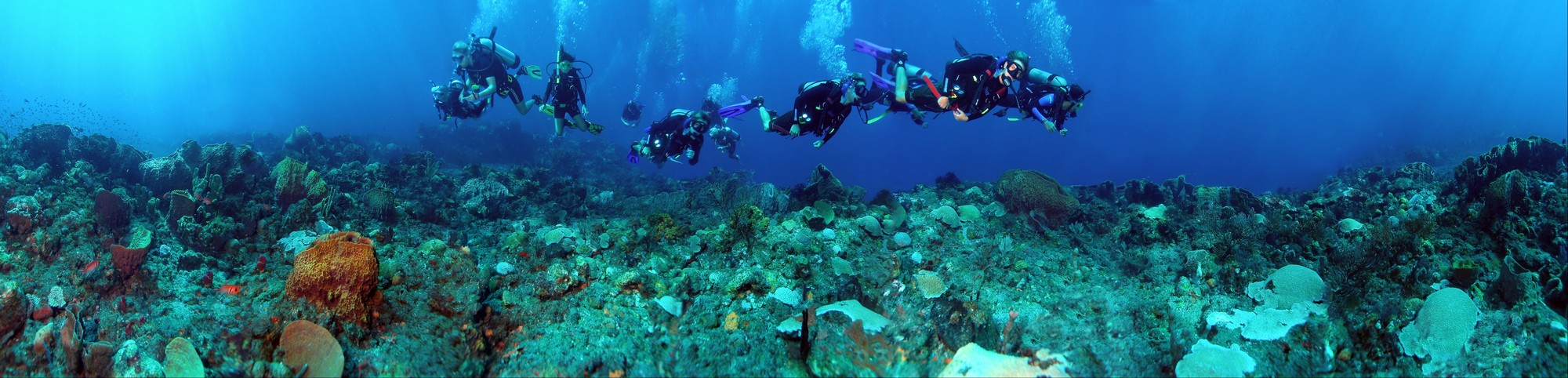 Odyssey Expeditions Students Explore 'Mystery Reef', St. Vincent
Mystery Reef is one of the best reefs in the Caribbean, teaming with large and small fishes, healthy corals, and strong currents.
Uploaded Aug 25, 2008 by Jason Buchheim username:odyssey copyright 2008
15,153px by 3,650px, 0.06 Gigapixels
| Unmounted | Acrylic Museum Mount |
| Purchase Prints | Matte | Glossy | Lustre | Metalic | Deep Glossy | Deep Glossy |
| 12" x 50" | | | | | | |
VIEW OPTIONS please select the approximate angle of view of the image
Flat 1° 10° 45° 90° 170°
Sphere 45° 90° 180° 270° 360°
Odyssey Expeditions Panoram.io VR billboard style
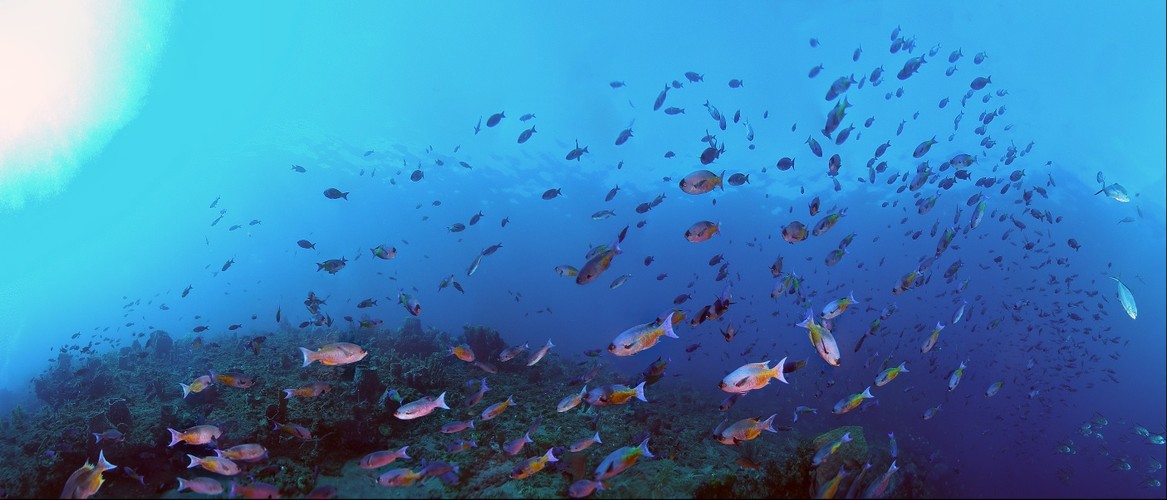 Creole Fish at Mystery Reef, St Vincent
On the rarely visited Northwest side of St Vincent is the most beautiful reef teaming with fishes and marine life. The Creole Wrasse are plaktivores, they eat plankton out of the water column above the reef. Strong currents bring in lots of plankton sweeping over the reef. The reef affords protection for the wrasses when the bar jacks and other piscivorous predators come for their turn at the dinner table.
Uploaded Aug 25, 2008 by Jason Buchheim username:odyssey copyright 2008
11,234px by 4,814px, 0.05 Gigapixels
| Unmounted | Acrylic Museum Mount |
| Purchase Prints | Matte | Glossy | Lustre | Metalic | Deep Glossy | Deep Glossy |
| 12" x 28" | | | | | | |
VIEW OPTIONS please select the approximate angle of view of the image
Flat 1° 10° 45° 90° 170°
Sphere 45° 90° 180° 270° 360°
Odyssey Expeditions Panoram.io VR billboard style
 ScallopedHammerhead and Whitetip Reef Sharks, Cocos Island, Costa Rica
Scalloped Hammerhead sharks congregate around Cocos Island, Costa Rica so that the females can be cleaned of parasites in their battle wounds by the barber fish cleaning stations. The males don't fight and they are there only because the females are. These are not man-eaters (like the Great Hammerhead).
Uploaded Jan 24, 2008 by Jason Buchheim username:odyssey copyright 2008
51,447px by 2,560px, 0.13 Gigapixels
| Unmounted | Acrylic Museum Mount |
| Purchase Prints | Matte | Glossy | Lustre | Metalic | Deep Glossy | Deep Glossy |
| 12" x 241" | | | | | | |
VIEW OPTIONS please select the approximate angle of view of the image
Flat 1° 10° 45° 90° 170°
Sphere 45° 90° 180° 270° 360°
Odyssey Expeditions Panoram.io VR billboard style
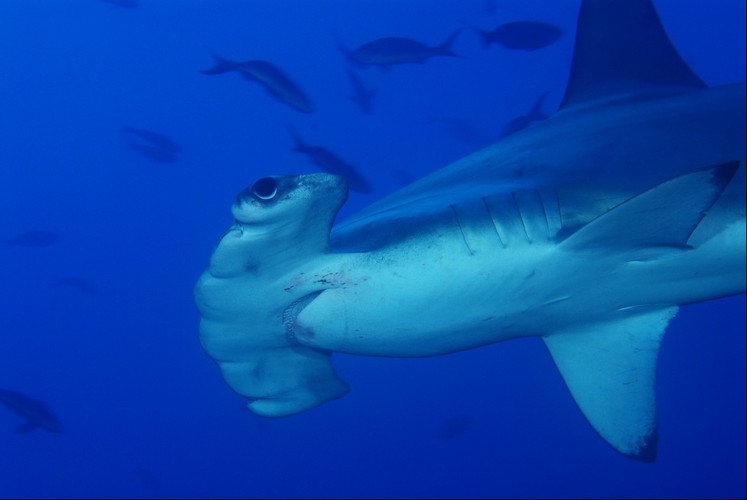 Scalloped Hammerhead Shark, Cocos Island, Costa Rica
The scalloped hammerhead (Sphyrna lewini) is one of the ocean's most iconic and socially complex sharks — and Cocos Island, Costa Rica sits at the heart of their world.
Why Cocos Island
Rising from the deep Pacific roughly 550 km southwest of mainland Costa Rica, Cocos Island (Isla del Coco) is one of the most remote and biologically rich marine environments on Earth. Its nutrient-rich upwellings, driven by converging Pacific currents, create a perpetual buffet that draws hammerheads in extraordinary numbers. The island is a UNESCO World Heritage Site and one of the top scuba diving destinations on the planet — largely because of these sharks.
The Schools
Scalloped hammerheads are unusual among sharks in their tendency to form large aggregations. At Cocos, divers routinely encounter schools of dozens to several hundred individuals swirling in slow, hypnotic formations along seamounts and cleaning stations like Dirty Rock and Alcyone. These gatherings are predominantly females, and researchers believe the schooling behavior is linked to social hierarchy, mating selection, and the use of the seamounts as navigational waypoints during long oceanic migrations.
The Hammer
The distinctive cephalofoil — that wide, flattened head — is far more than an unusual silhouette. It is densely packed with electroreceptors called ampullae of Lorenzini, giving scalloped hammerheads an extraordinarily sensitive ability to detect the faint electrical fields produced by prey buried in sand or hiding in reef crevices. The wide-set eyes also provide nearly 360° of vision, with just two small blind spots directly in front and behind.
Diet and Behavior
At Cocos they feed primarily on fish, squid, octopus, and stingrays. They are active, strong swimmers that undertake deep daily dives — sometimes exceeding 500 meters — likely to cool their bodies and hunt in the mesopelagic zone before returning to warmer, shallower water.
Conservation Status
Scalloped hammerheads are listed as Critically Endangered on the IUCN Red List. Their fins are among the most valued in the shark fin trade, and their slow reproductive rate — bearing live young (viviparous) in litters of 15–30 pups after a roughly 9–12 month gestation — makes population recovery painfully slow. Costa Rica's 22-nautical-mile no-fishing exclusion zone around Cocos offers meaningful protection, and the island's remoteness has helped it remain one of the last places on Earth where witnessing a large hammerhead school is still possible.
Uploaded Jan 24, 2008 by Jason Buchheim username:odyssey copyright 2008
7,744px by 5,184px, 0.04 Gigapixels
| Unmounted | Acrylic Museum Mount |
| Purchase Prints | Matte | Glossy | Lustre | Metalic | Deep Glossy | Deep Glossy |
| 12" x 18" | | | | | | |
VIEW OPTIONS please select the approximate angle of view of the image
Flat 1° 10° 45° 90° 170°
Sphere 45° 90° 180° 270° 360°
Odyssey Expeditions Panoram.io VR billboard style
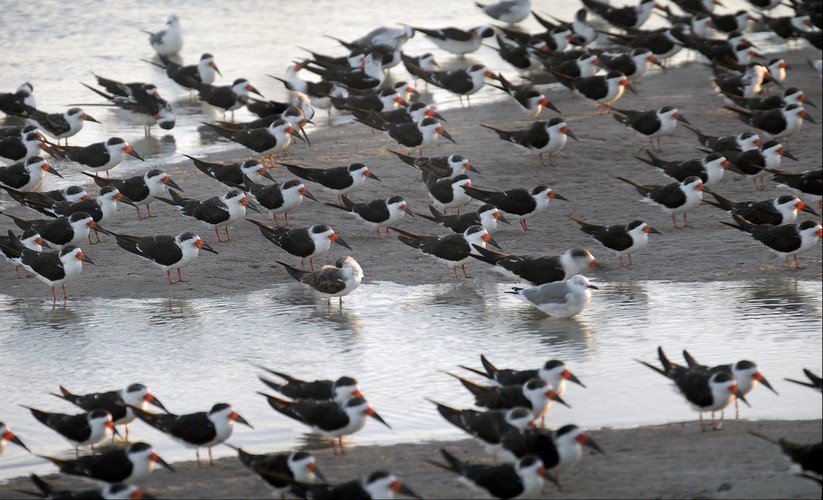 Black Skimmers, the endangered beach bird, Crystal River, Florida
Black Skimmers are unmistakable coastal seabirds renowned for their uniquely elongated lower beaks. They forage by flying incredibly low, plowing the water's surface to catch small fish. Found on sandy beaches and barrier islands, they are highly sensitive to human disturbance and nest directly in the sand.Distinctive FeaturesThe "Scissorbill": They are the only birds in North America with a lower mandible significantly longer than the upper one. The blade-like lower beak cuts through the water, snapping shut instantly upon contact with a fish.Cat-like Eyes: Unlike most birds, skimmers have vertical pupils that narrow to slits to protect their eyes from the intense glare of the sun and reflective water.Plumage: They have jet-black backs and caps, striking white underparts, and vibrant orange-red legs and bills (with a black tip).Feeding BehaviorTouch Foraging: Skimmers hunt by feel rather than sight. They glide just inches above calm tidal waters, skimming the surface with their lower beak to trigger a rapid bite when prey is encountered.Active Timing: They most actively forage at dawn, dusk, or even at night when waters are calmer and small fish are near the surface.Diet: They feed primarily on small fish (under 5 inches), as well as shrimp and small crustaceans.Habitat & BreedingColonial Nesters: They gather in large, dense colonies on flat, open, sandy beaches, shell bars, or barrier islands, often alongside terns.Nest in the Open: The nest is just a shallow scrape in the sand, where they lay clutches of 3 to 4 eggs.Nesting Season: In Florida and the broader Southeast, they breed primarily during the summer months.Conservation StatusBlack skimmers face ongoing population pressures and are listed as a State-designated Threatened species in Florida. Their habit of nesting directly on open sand makes them highly vulnerable to habitat loss, beach development, off-leash pets, vehicle traffic, and storm surges.If you are exploring the coastal beaches around Tarpon Springs, look out for flocks resting on the sandbars and always observe them from a safe distance so you don't disturb their nesting or feeding grounds.
Uploaded Jan 24, 2008 by Jason Buchheim username:odyssey copyright 2008
12,190px by 7,410px, 0.09 Gigapixels
| Unmounted | Acrylic Museum Mount |
| Purchase Prints | Matte | Glossy | Lustre | Metalic | Deep Glossy | Deep Glossy |
| 12" x 20" | | | | | | |
| 18" x 30" | | | | | | |
| 24" x 39" | | | | | | |
VIEW OPTIONS please select the approximate angle of view of the image
Flat 1° 10° 45° 90° 170°
Sphere 45° 90° 180° 270° 360°
Odyssey Expeditions Panoram.io VR billboard style
All images uploaded to and reside only at Gigapan®.com. Image copyrights by respective photographers.
This site does not copy or store any images and only provides the viewer KRPANO panorama viewing software, necessary configuration XML and proxy using the public Gigapan® API.