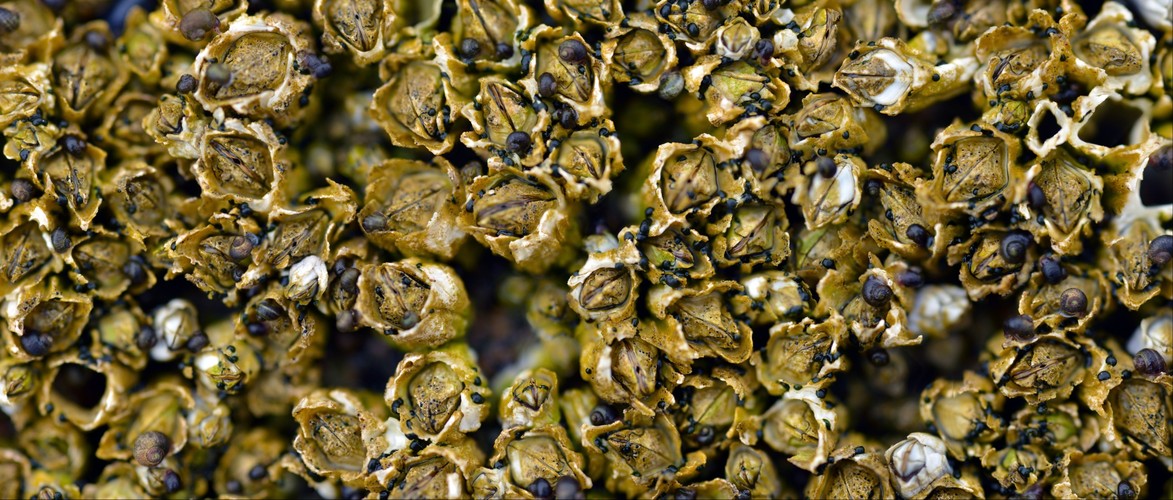
Barnacles, Mussels, Snails - Rocky Intertial Acadia Maine
Barnacles, periwinkles, and blue mussels crowded together on exposed granite — this is the intertidal zone of Acadia National Park, Maine, and few ecological communities on the Atlantic coast are as rugged, competitive, or quietly dramatic as this one.
Acadia's Intertidal
The rocky coastline of Acadia National Park along Mount Desert Island represents some of the most studied and celebrated intertidal habitat in North America. Shaped by some of the most extreme tidal ranges on the U.S. East Coast — regularly swinging six to twelve feet between low and high tide — these rocks are exposed to air, drenched in seawater, baked by summer sun, and locked in winter ice, sometimes within the same day. Life here is organized into distinct horizontal bands, each species staking out the precise elevation it can physiologically tolerate.
The Barnacles
The dominant barnacles in Acadia's intertidal are most likely acorn barnacles — primarily Semibalanus balanoides, the northern rock barnacle, which carpets the mid-to-high intertidal in dense, chalk-white colonies. What appears to be a crusty mineral encrustation is actually a community of animals. Each cone is an individual crustacean — closely related to crabs and shrimp — that has cemented its head permanently to the rock and built a volcano-shaped limestone fortress around itself. When submerged, the plates at the top open and feathery feeding appendages called cirri sweep the water for plankton in rhythmic, raking strokes. When the tide retreats, the plates clamp shut, sealing in moisture and protecting soft tissue from desiccation and predators. A barnacle can survive hours of aerial exposure that would kill most marine invertebrates.
The Periwinkles
The small snails grazing among the barnacles are almost certainly common periwinkles (Littorina littorea), an intertidal species so successful it has become one of the dominant grazers on the entire New England coast. Periwinkles rasp algae and biofilm from rock surfaces using a ribbon of tiny teeth called a radula, and their grazing pressure actually shapes which species of algae and organisms can establish themselves — making them quiet but powerful ecological engineers. They are extraordinarily tolerant of exposure, capable of sealing their shell opening with a tough plate called an operculum and entering a dormant state during low tide. Periwinkles are also, notably, a non-native species introduced from Europe in the 1800s that has thoroughly naturalized into the New England intertidal ecosystem.
The Mussels
The blue mussels (Mytilus edulis) nestled into the barnacle matrix represent the intertidal's master colonizer. Mussels attach to rock and to each other using byssus threads — strong, elastic protein fibers secreted from a gland near the foot — forming dense mats that can eventually outcompete barnacles for space if left unchecked. They are filter feeders, drawing water through their gills and straining out phytoplankton and suspended organic matter with extraordinary efficiency. A single mussel can filter more than a liter of seawater per hour. Their aggregations create habitat for dozens of other small invertebrates — worms, amphipods, small crabs — sheltering within the mussel matrix like a city within a city.
The Competition
What looks like a static rock surface is in ecological terms a slow-motion battlefield. Barnacles, mussels, algae, and periwinkles are in perpetual competition for the most precious intertidal resource — bare rock to settle on. Barnacles colonize open space quickly after disturbance, mussels can overgrow them, sea stars (Asterias forbesi and A. vulgaris) prey heavily on mussels from below at low tide, and winter ice scour periodically resets patches to bare rock and starts the succession over. The ecologist Robert Paine's foundational work on intertidal community structure — including the concept of the keystone species — grew directly out of research conducted in this kind of rocky intertidal habitat.
Seasonality in Maine
In Acadia, the intertidal community shifts with the seasons in ways invisible in warmer climates. Barnacles spawn in late winter and early spring, releasing nauplii larvae into frigid water. By late spring, newly settled barnacle spat — barely visible to the naked eye — dust the rock in a faint haze of white. Summer brings maximum biological activity, predation pressure, and algal growth. Winter strips some of the softer community back and, in hard freeze years, ice rafting physically tears mussel beds and barnacle patches from the rock entirely, creating the disturbance patches that the community then races to recolonize come spring.
Uploaded Oct 10, 2012 by Jason Buchheim username:odyssey copyright
17,708px by 7,547px, 0.13 Gigapixels
| Unmounted | Acrylic Museum Mount |
| Purchase Prints | Matte | Glossy | Lustre | Metalic | Deep Glossy | Deep Glossy |
| 12" x 28" | | | | | | |
| 18" x 42" | | | | | | |
| 24" x 56" | | | | | | |
VIEW OPTIONS please select the approximate angle of view of the image
Flat 1° 10° 45° 90° 170°
Sphere 45° 90° 180° 270° 360°
Odyssey Expeditions Panoram.io VR billboard style
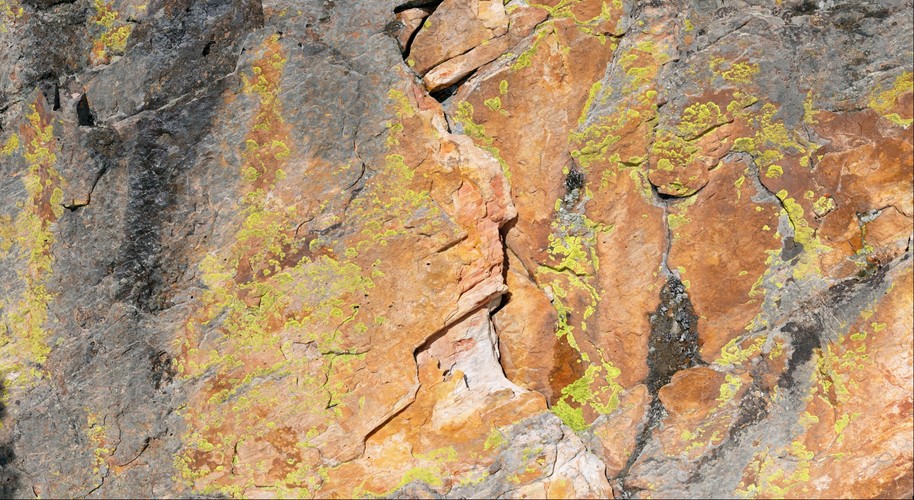
Indians Eye to Eye (lichen covered boulder)
This lichen covered boulder is in the backcountry of Snowmass, Colorado, on Burnt Mountain. I have been thinking of photographing this site for over a year and finally made it out with the Gigapan mount and tripod way out in the wilderness. Actually, the day before, I was here trying to photograph this by hand. I was concentrating really hard on lining up each shot to make a handheld Gigapan. I was about half way through when I heard some snowboarder on the hill above me yelling "hey, photographer, enough with the photos of the rock, move out of the way already" Well, I wasn't done, and I did not want to loose my 'nodal point' position. Besides, we were in the backcountry wilderness, there are a million different routes to go. But they wanted to go right where I was standing. I told them to go around. They did not understand why I would not just move. I understand that it is not obvious to a layman why moving would ruin my shot in progress. I held my ground. The first fellow snowboards by me no problem. The second fellow PUNCHES me as he is going by. Luckily it was a weak punch, but it did throw him off balance and he crashes landing upside down in a tree well below me. Well, I did not escalate the situation further beyond calling him an mild expletive. He dug himself out and did not crawl back up to my little spot on the planet.
Here is another view of this boulder from the year before (lots of snow) http://share.gigapan.org/viewGigapan.php?id=3124
I shot this as a High Dynamic Range 3 images per location, but I could not find stitching software that would stitch it. PtGUI would align it great but would never stitch it, it just halted upon stitching. Autopano Giga kept crashing... So this is not the HDR version, and the Gigapan Stitcher performed marvelously.
Personally I feel this image has a painterly feeling, but the painter would have to be Jackson Pollack. Its very abstract, with lots of random splashes of color about.
It seems that the lichens like to live in the moister regions of the boulder, in the cracks on non-vertical faces. There definitely is a gradient of the lichen species with the amount of water that can be held onto. The fleshier lichens are in the cracks. Its amazing to think that this is the thickness of the life on the surface of the earth at this place, just a thin crusting between hard rock and atmosphere!
Lichens (IPA: /ˈlaɪkən/) are composite organisms consisting of a symbiotic association of a fungus (the mycobiont) with a photosynthetic partner (the photobiont or phycobiont), usually either a green alga (commonly Trebouxia) or cyanobacterium (commonly Nostoc). The morphology, physiology and biochemistry of lichens are very different to that of the isolated fungus and alga in culture. Lichens occur in some of the most extreme environments on Earth—arctic tundra, hot deserts, rocky coasts and toxic slag heaps. However, they are also abundant as epiphytes on leaves and branches in rain forests and temperate woodland, on bare rock, including walls and gravestones and on exposed soil surfaces (e.g. Collema) in otherwise mesic habitats. Lichens are widespread and long-lived however, many species are also vulnerable to environmental disturbance, and may be useful to scientists in assessing the effects of air pollution, ozone depletion, and metal contamination. Lichens have also been used in making dyes and perfumes, as well as in traditional medicines.
Stitcher: 0.4.4090 Images: 221 (17 columns by 13 rows) Camera: Panasonic DMC-FZ50 Capture time: 2009-03-28 16:05:33 - 2009-03-08 16:27:41 Aperture: f/11 Exposure: 0.00625 ISO: 100 Focal Length (35mm equiv): 420.0mm Horizontal Overlap: 14.3 to 19.7 Vertical Overlap: 15.8 to 23.8 Computer Stats: 2046 MB RAM 4 CPUs Total Time: 2:28:39 (0:40 per picture) Alignment: 24:01, Projection: 9:09 Blending 1:55:28
Uploaded Apr 1, 2009 by Jason Buchheim username:odyssey copyright 2009
51,815px by 28,355px, 1.47 Gigapixels
| Unmounted | Acrylic Museum Mount |
| Purchase Prints | Matte | Glossy | Lustre | Metalic | Deep Glossy | Deep Glossy |
| 12" x 22" | | | | | | |
| 18" x 33" | | | | | | |
| 24" x 44" | | | | | | |
| 30" x 55" | | | | | | |
| 36" x 66" | | | | | | |
VIEW OPTIONS please select the approximate angle of view of the image
Flat 1° 10° 45° 90° 170°
Sphere 45° 90° 180° 270° 360°
Odyssey Expeditions Panoram.io VR billboard style

Moonlit Canyonlands National Park, Utah
On a mountain bike trip through the Canyonlands National Park in Utah on the White Rim road, we spent one of three nights at 'Murphys' plateau. I had to pee in the middle of the full moon night and decided to take this long exposure (30 seconds each) night shot of the desert (thats why its soo grainy- its moonlit)
Uploaded Apr 24, 2008 by Jason Buchheim username:odyssey copyright 2008
25,673px by 2,496px, 0.06 Gigapixels
| Unmounted | Acrylic Museum Mount |
| Purchase Prints | Matte | Glossy | Lustre | Metalic | Deep Glossy | Deep Glossy |
| 12" x 123" | | | | | | |
VIEW OPTIONS please select the approximate angle of view of the image
Flat 1° 10° 45° 90° 170°
Sphere 45° 90° 180° 270° 360°
Odyssey Expeditions Panoram.io VR billboard style